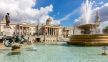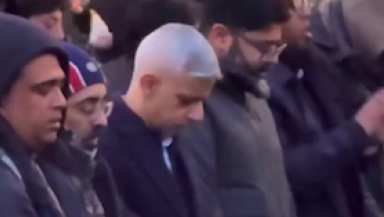
The row over the controversial mass Islamic prayer in Trafalgar Square last week continues to rumble on, with Christian figures at odds over the best response.
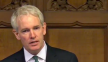
Conservative MP Nick Timothy, himself a Christian, was criticised for saying the event was an act of “domination” that should never be repeated. He particularly took issue with an Islamic prayer known as the adhan, which he said was an “explicit repudiation” of Christianity and all other faiths.
Prime Minister Keir Starmer said that Timothy should be sacked from the Conservative front bench and defended the Islamic event on the grounds that people should be free to publicly express their faith.
Christian writer Lois McLatchie-Miller noted the irony of such a defence, when silent prayer in abortion clinic buffer zones is criminalised, leading to a number of arrests of Christians.
Writing for The Spectator, McLatchie-Miller said, “While Muslims are welcomed to pray loudly and openly in large groups in the centre of London, under the ‘buffer zone’ legislation championed in 2024 by MPs … those who pray publicly in the street outside abortion clinics – even if they do so alone, and even if they pray silently in their own minds – could swiftly find themselves in trouble.”
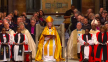
Not all Christians have sided with Timothy, however. The Bishop of Willesden, Lusa Nsenga-Ngoy, celebrated the fact that the controversial event took place.
"The public iftar in Trafalgar Square was not an act of cultural imposition, nor a signal of division. It was, rather, a moment of hospitality: an invitation to share in the breaking of the fast during Ramadan, extended by one community to the wider public. It was open, generous and peaceful," he said.
He also spoke of “the gift, of a society shaped not by uniformity, but by a deep and textured plurality of belief, practice and identity.”
The bishop’s position has been questioned by Tim Dieppe, head of public policy at Christian Concern, who said: "This nation was once great because it explicitly chose to worship the Christian God and to honour him as far as possible. In recent decades it has sadly turned away from this path and we are starting to reap the consequences. One of which is rival religions vying for influence in our culture.
"You can’t have a neutral public square where every worldview or religion has an equal space. This is actually an anti-Christian position which denies that the only true God is the Christian God. A secular state isn’t neutral either. It denies the truth of Christianity."
Dieppe said he firmly sided with Timothy.
“These growing public displays of ritual prayer and proclamation of the Adhan are intended to demonstrate and increase the influence of Islam. They are an act of domination. Freedom of religion has limits," he said.
“By all means, worship Allah in a mosque, even engage in Dawah on the streets, but I would draw the line at mass ritualistic prayers in public places like this. Unless we are prepared to draw lines like this, Islam will gradually take over this nation.”