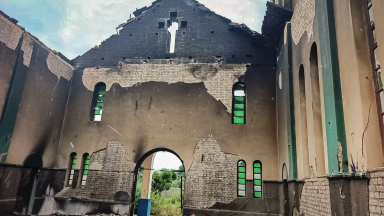
Church leaders in northern Mozambique have renewed calls for peace and religious unity after militants destroyed a historic church during a violent raid in Cabo Delgado Province.
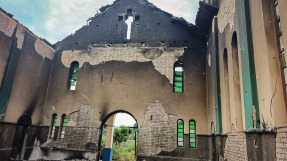
The attack targeted St Louis de Montfort parish in the village of Minhoene, close to Meza, where armed insurgents reportedly burned church buildings, damaged a kindergarten, and destroyed the priests’ residence.
No fatalities were reported during the assault, which took place on Thursday, April 30.
Local sources reported to Catholic charity Aid to the Church in Need (ACN) that fighters linked to Islamic State: Central Africa Province were responsible.
President of Mozambique’s Bishops’ Conference Archbishop Inácio Saure condemned the violence and urged an end to attacks carried out in the name of religion.
“Let the destruction and the killing cease,” he told ACN, while also warning against hostility toward Muslims. “The Muslims are not our enemies, they are our beloved brethren.”
The archbishop said the violence contradicts Mozambique’s long history of coexistence between religious communities.
Church officials described scenes of devastation after the attack.
Bishop António Juliasse said entire sections of the parish had been left in ruins and that residents were traumatised by the events.
“It was a scene of terror,” he said. “Homes, infrastructure, all destroyed.”
He added that civilians had reportedly been detained by the attackers and forced to listen to extremist speeches before the militants left the area.
Established in 1946, St Louis de Montfort parish has long served as a Catholic centre in a predominantly Muslim region of northern Mozambique.
The parish is cared for by Cameroonian missionary priests, who were away when the raid occurred.
Although the clergy escaped unharmed, Bishop Juliasse told ACN that the local Christian community remains deeply shaken.
Since the insurgency in Cabo Delgado began in 2017, over 6,300 people are believed to have been killed and no less than one million displaced.
The terrorist movement, locally referred to as Al Sunnah wa Jama’ah or Al-Shabab - separate from the Somali and Kenya-based group of the same name - is linked to Islamic State: Central Africa Province.
Church sources reported to ACN that jihadists have demolished no fewer than 118 Christian worship sites.
Despite the repeated attacks, Bishop Juliasse said: “For nine years, we have watched the insurgents burn chapels and churches in the Diocese of Pemba. But the faith of God’s people will never burn.”
ACN said it continues to support communities in Mozambique through humanitarian assistance and trauma recovery programmes.
Bishop Juliasse said: “We ask for attention and solidarity for the victims of Meza.”