When Pete Hegseth invoked the wrath of God against the Iranians, it caused alarm to many people who were politically left of his own brand of evangelical Republicanism. One of the people triggered by it now seems to have been the Pope.
On Palm Sunday, he offered a homily which rebuked politicians who had blood on their hands. Commentators, who included me, would immediately ask whether or not the Pope was getting involved in the foreign policy issues that governed the Iranian war.
I, at one point, thought that there might just be a little bit of wiggle room - that he was annunciating principles of geopolitical Catholic ethics rather than rebuking the American administration.
It looks as though I was wrong.
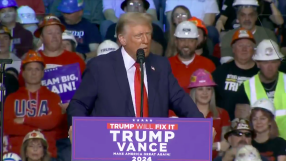
Suddenly, today, a spat of words has broken out between President Trump and Pope Leo, and apart from intensifying antagonism and misunderstanding, it is not easy to see what good will come out of it.
President Trump has his own style of communication. It is full of provocative aggression, hyperbole, and full-on confrontation. It is how he has done deals the whole of his life. He creates outrage and apoplexy in his opponents. This very often has the effect of wrong-footing them. It has worked very well for him.
A phrase has even been coined in response to those who take him too seriously - Trump Derangement Syndrome.
One of the questions we have to ask ourselves is whether or not the Pope has a moral and public duty to comment on President Trump’s tasteless, aggressive, but often effective hyperbole.
Whether or not we think he has such a moral duty, the Pope did comment, and perhaps almost inevitably this produced a furious response from President Trump.
Pope Leo’s response on his plane flight to Argentina was this:
“I have no fear of either the Trump administration or of speaking out loudly about the message of the Gospel. And that’s what I believe I am called to do, and what the Church is called to do. We are not politicians. We are not likely to make foreign policy with the same perspective as he might understand it. But I do believe the message of the Gospel - blessed are the peacemakers - is a message the world needs to hear today.”
How can one criticise the Pope? Everything he said is true.
The difficulty is that even if he did not think he was speaking in a way intended to correct American foreign policy, the President and his advisers heard it in that way - as if they were being rebuked.
One of the questions that arises from this exchange is why the Pope is directing his ethical remarks at the American administration rather than the Iranian administration. Why is it that the Iranian administration and its actions do not find a place in his public teaching or moral concern.
A good deal, of course, depends on one’s presuppositions. It may be that being triggered by Pete Hegseth’s aggressive religiosity affects one’s presuppositions.
But on the other side of the argument, there are those who believe that Trump may have saved the world from a nuclear winter.
There was a school of intelligence that said that the Iranians were only weeks away from being able to produce a nuclear bomb.
Whilst mutually assured destruction has saved the world since the atomic bomb was invented, there was always going to be an exception to that safety - and that was if you could no longer count on the sanity and instinct for self-preservation on both sides.
To those who understand the theological priorities of the Iranian ruling regime, this is one group for whom mutually assured destruction holds no terror and exercises no restraint. The particular brand of Islam they follow teaches that they have a duty to bring on apocalyptic disaster in order to fulfil their eschatological expectations.
If you think that the Iranians were close to having a nuclear bomb, and if you take seriously their determination to destroy Israel and wipe it out “from the river to the sea,” and if you believe that this is consistent with a lack of restraint in terms of the nuclear exchange this might provoke, then you would reach the conclusion that the work of President Trump has been to save the world from nuclear disaster. This is not a view that can be proved, but it is certainly a position that ought to be entertained.
When the Pope proclaimed “blessed are the peacemakers,” is it possible that saving the world from nuclear holocaust might constitute an act of peacemaking?
Some historical curiosity may help.
His predecessor was faced with an invasion of the Huns and their deadly and highly successful advance, sweeping in from the East and threatening Western civilisation with disaster.
The invasions of Attila with his force of Huns were terrifyingly successful. Beyond the impact of a huge body count, they created psychological terror, the collapse of cities, mass displacement, and civilisational shock.
Pope Leo I saw it as his duty to travel to meet Attila in person - which he did in 452 AD near the River Mincio in Italy.
After the confrontation between the two men, Attila withdrew.
Some people claimed it was a miracle. Others said it was in response to disease, threats to his rear, and his need to find a face-saving reason for withdrawing. But nonetheless, instead of entering into a war of words, the Pope became a negotiator with the chief cause of the threat to civilisation.
Might Pope Leo XIV take some inspiration from Leo I. Instead of confronting the loud, highly hyperbolic, destabilising President Trump, he might have arranged a meeting with the Iranian leaders.
If he was going to use his considerable moral authority to improve the conditions for peacemaking, it may be that the people he ought to have been talking to were the Iranians rather than the American administration.
It is very awkward for Catholics to find themselves caught up in a war of words between the office of the Papacy and the Presidency of the United States. Perhaps the best news to come out of today’s events is the Pope saying he did not intend to continue the war of words with the administration.
I found myself in demand in media studios after the public spat - at Times Radio, LBC, and elsewhere - trying to explain why Catholics might be reluctant simply to side with the Pope against the larger-than-life figure of the Presidency.
Bishop Barron suggested, in a useful intervention, that if Pope Leo and President Trump were unable to communicate easily at the level of megaphone diplomacy between the two offices, then senior American politicians ought to meet senior Vatican diplomats to see if they could create a less fraught channel of communication.
What this moment reveals is not simply a clash of personalities, but a deeper confusion about the nature of moral authority in a disordered world.
The Pope is right to preach the Gospel. He is right to remind the world that peace is the ultimate good. But peace is not always served by directing moral rebuke at those who may - however imperfectly - be attempting to restrain greater evils.
If the Church is to act as a true instrument of peace, it must be seen to speak with equal clarity to all parties, especially to those whose actions and ideologies most threaten the fragile order of the world.
Otherwise, even the truth, when unevenly applied, risks being heard not as prophecy but as partiality.
History offers us a lens through which to judge the present. When Leo I rode out to meet Attila, he did not merely speak about peace - he confronted the source of the threat to it.
That is the burden, and the privilege, of moral authority at its highest level: not simply to proclaim principles, but to direct them where they are most needed.
If the Church is to stand once again as a stabilising force in a dangerous world, it must ensure that its voice is not only heard - but rightly aimed.
Because in times such as these, the difference between peacemaking and misjudgment may not be measured in words - but in consequences.
Read more from Gavin Ashenden at https://drgavinashenden.substack.com/