Christians have reacted with sadness after members of the House of Lords failed to back amendments that would have removed the decriminalisation of abortion up to birth from the Crime and Policing Bill.
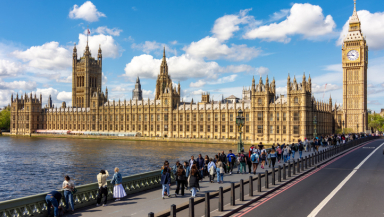
Baroness Monckton’s amendment sought to remove clause 208, which contains the decriminalisation proposals, entirely from the bill but peers voted against it by 185 to 148 following a debate on Wednesday evening.
Clause 208 does not change the current 24 week legal limit at which a woman can have an abortion but it removes criminal sanctions for women who carry out their own abortions beyond this point.
Peers also voted against Baroness Stroud’s amendment to reinstate in-person consultations with a medical professional prior to at-home abortions by 191 votes to 119.
This has dismayed Christian and pro-life groups who say it effectively legalises abortion up to birth in the UK for any reason, including on sex-selective grounds.
Simon Calvert, deputy director of The Christian Institute, said, “It is unutterably grim that the House of Lords has voted to permit a woman to take the life of her baby just days before birth.
"They have shown little regard for public feeling which is strongly opposed to this. They have dehumanised the unborn to a shocking new degree. And they have abandoned women.
"Those of us who care about the unborn and their mothers must renew our efforts to expose the consequences of what our politicians have done today so that, one day, it can be reversed.”
Right to Life UK said it will result in "one of the most significant changes to abortion legislation since 1967" - when abortion was first made legal.
"If this bill becomes law, it will likely lead to a significant increase in the number of women performing late-term abortions at home, endangering the lives of many more women," it said.
This is despite the fact that polling by Savanta ComRes has found that only one per cent of UK adults support abortion up to birth, while 89% of the general population and 91% of women believe gender-selective abortion should be explicitly banned by the law.
Peter Lynas, UK Director of the Evangelical Alliance, said the votes were "sad news" and that he was "deeply concerned" by them.
He said that without in-person consultations, the pills-by-post service is missing "a crucial safeguard for women's safety and wellbeing".
"The vote removes any legal deterrent and weakens vital safeguards for women and unborn children," he said.
"As Christians, we believe every life has inherent dignity. Parliament must now act to address the risks created by this decision, ensuring women in crisis pregnancies receive compassionate, life-affirming support, and that both mother and child are cared for with dignity before and after birth."
The Society for the Protection of Unborn Children (SPUC) called the votes "disappointing" and said it hoped the decisions taken on Wednesday evening can be revisited at Third Reading.
Michael Robinson, executive director of SPUC, said the measures were being "pushed through without any pre-legislative scrutiny, public consultation or a detailed impact assessment".
“Watering down the safeguards in the Abortion Act, by tagging on some amendments to the Crime and Policing Bill, has meant that the full impact of this change has not been fully scrutinised or debated," he said.
He warned that the changes "will lead to late term abortions being carried out on babies who if born in hospital would stand a good chance of surviving".
He also raised concerns that there will be more cases of the pills-by-post service being abused, something that has already been seen in the case of Stuart Worby who was imprisoned after using a female friend to obtain abortion drugs in the post and slip them into his pregnant girlfriend's drink. She lost the baby and was so badly affected that she is now unable to have children.
"We know that Matt Hancock’s pills by post policy, which legalised DIY home abortions has led to a massive increase in 999 calls and ambulance call outs, at the same time removing the important safeguard of a face-to-face discussion with a doctor," said Mr Robinson.
Speaking during the debate, the Archbishop of Canterbury, Dame Sarah Mullally, reminded the Lords of the Church of England's "principled opposition" to abortion before going on to speak in support of Baroness Monckton and Baroness Stroud's amendments.
"The infinite value of human life is a fundamental Christian principle which underpins much of our legal system and has shaped existing laws on abortion. All life is precious ... " she said.
Setting out why she could not support clause 208, she said, "Though its intention may not be to change the 24 week abortion limit, it undoubtedly risks eroding the safeguards and enforcements of those legal limits, and inadvertently undermining the value of human life."
Dame Sarah, who is the former government's Chief Nursing Officer for England, said, "It is not clear how the law can function in an enforceable way without in-person consultation before accessing early medical abortion. The risks, as we have heard of medical complication is much greater if the pills for early abortion are taken beyond the 11-week limit."
She continued: "As I've already said, this is not a debate on whether the legal abortion limit should change but we are at risk of it becoming exactly that without the leave as necessary to monitor and enforce the law."