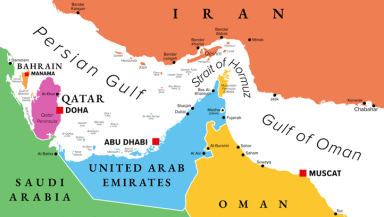
Seafarers in the Gulf have become the helpless victims of the battle being fought around them – according to the head of a charity supporting nearly two million crewmen and women working on ships across the world.
Peter Rouch, secretary-general of the Mission to Seafarers, and an Anglican priest, has described the helplessness experienced by seafarers in the Arabian Gulf, on ships that could find themselves under attack. The charity’s latest prayer diary encourages prayer for seafarers in the region.
In a message to the mission’s supporters, he writes, “Imagine, for a moment, standing on the deck of a vast steel vessel, its holds packed with cargo that – under the wrong conditions – could become catastrophically volatile.
“The horizon is not empty but alive with the streaks of missiles, the thud of interceptions, the uneasy choreography of modern warfare playing out in the sky above you. There is no shelter to run to, no quick exit, no safe distance to be gained.”
He explains, “The human body is not designed for such stillness in the face of danger. Deep within us, older than reason, is the instinct to flee or fight. It announces itself in a rush: the quickening pulse, the tightening muscles, the sharpened senses. A command, as ancient as it is urgent: get out.
“But at sea, in such moments, there is no ‘out’.”
The Mission to Seafarers (MtS) – founded in 1836 as the ‘Bristol Channel Mission’ – now has a presence in 200 ports in 50 countries worldwide. MtS is the largest seaport-based welfare organisation in the world supporting seafarers 365 days per year, regardless of their rank, nationality, gender or religion. It has a network of chaplains across the globe.
Security constraints mean that current access to seafarers around the Gulf by the MtS is restricted.
Peter Rouch, a former archdeacon in the Church of England, explains, “The quiet, pastoral presence that MtS people would normally offer – a visit, a conversation over coffee, a listening ear on the quayside – has been replaced, in many cases, by a telephone call or the blink of a WhatsApp message.
“Support continues, especially for those in the most precarious circumstances, including abandoned vessels. But the human proximity that matters so much is harder to offer.”
Mr Rouch highlights the helplessness and vulnerability felt by the seafarers, in addition to their isolation from their loved ones that is a feature of life at sea. Communications have often been disrupted by the attacks around them.
He explains, “For seafarers in The Gulf, the body’s alarm continues to sound, but the action it demands is impossible. The result is not simply fear, but a prolonged, grinding strain. Over time, that sustained state of alertness takes its toll: exhaustion, anxiety, a loss of appetite, the slow erosion of both physical and mental resilience.
“Layered upon this is another, quieter burden. The familiar ache of separation from home – already a defining feature of life at sea – deepens into something sharper, more uncertain. The question shifts. Not 'when will I see them again?' but ‘will I?’.”
Mr Rouch calls on the world to remember the seafarers caught up in the midst of the war, to respond with compassion to their vulnerability. and support those who seek to help the seafarers.
He appeals for attention to be paid to the plight of those who work on the ships that transport vast amounts of vital goods around the world – including through some of the globe’s troublespots.
He explains, “As tensions in the Gulf continue to unfold, it is worth holding in mind both those on the ships – waiting, watching, enduring – and those who, like our own MtS staff still working with dedication in the region, remain committed to supporting them, often in difficult and constrained circumstances.
“Their work may not command headlines. It rarely does. But it matters.”
The Mission to Seafarers publishes a monthly prayer diary and encourages prayer for seafarers across the world. Its April diary calls for prayer for the safety of seafarers in the Persian Gulf and Strait of Hormuz, for all seafarers affected by the conflict in the Middle East, and for seafarers transiting the Red Sea and other areas where warfare and piracy is encountered.
Rev Peter Crumpler is a Church of England minister in St Albans, Herts, and a former communications director with the CofE.