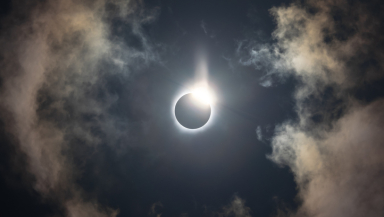
The Gospels describe three hours of darkness from noon at the crucifixion of Jesus, prompting debate over whether this was an eclipse. This is the story …
The Crucifixion account
The story of the crucifixion is so important that it is covered in all four Gospel accounts in the New Testament. Three of them, known as the Synoptic Gospels of Matthew, Mark, and Luke, all describe a darkness over the land. In Matthew it says: “From the sixth hour there was darkness over all the land unto the ninth hour” (Matthew 27:45, KJV). Mark states: “And when the sixth hour had come, darkness came over all the earth until the ninth hour” (Mark 15:33, KJV). Matthew and Mark report “darkness over all the land” without specifying the cause. The sixth hour was measured from dawn, so they meant what we call noon.
Symbolism of darkness
Many people see a fulfilment of prophecy from Isaiah, who prophesied, “I clothe the heavens with blackness, and I make sackcloth their covering” (Isaiah 50:3); and from Amos, who prophesied, “And it shall come to pass in that day, saith the Lord GOD, that I will cause the sun to go down at noon, and I will darken the earth in the clear day” (Amos 8:9). Others point to Joel, who prophesied: “The sun will be turned to darkness and the moon to blood, before the coming of the great and glorious day of the LORD” (Joel 2:32).
The word “eclipse”
The idea that there was an eclipse at the crucifixion comes from the Greek word “ἐκλιπόντος” (eklipontos), which appears in the original text of the account found in Luke 23:45. The Greek word “ἐκλείπω” (ekleipo) is the origin of the English word “eclipse”. In English, as in Greek, it can mean something is darkened or obscured. The Greek word has come into English to be used mainly in the astronomical sense of the obscuring of the sun or the moon, as in solar and lunar eclipses. In English, the word “eclipse” is also used metaphorically, such as in Bonnie Tyler’s 1983 hit song “Total Eclipse of the Heart”, or in phrases like “His fame was eclipsed by a newcomer” or “The war has eclipsed all other issues in the news”.
Astronomical eclipses
The planet Earth orbits the sun in an elliptical orbit each year, and the moon revolves around the Earth in an orbit each month. Sometimes the moon is directly between the Earth and the sun, or the Earth is directly between the sun and the moon. The moon goes through phases: when one face is fully visible, it is called a “full moon”; at other times there is a half-moon, a crescent moon, or a “new moon”, when the moon is nearly invisible.
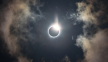
A solar eclipse occurs when the moon passes between the Earth and the sun, temporarily blocking the sunlight and casting a dark shadow upon the Earth. Because the sun is behind the moon, it appears as a “new moon”. In contrast, a lunar eclipse happens when the Earth positions itself between the sun and a “full moon”, when the side facing Earth is illuminated. When the Earth blocks all sunlight to the moon, it causes the Earth’s shadow to fall on the moon, making it appear reddish instead of white - sometimes called a “blood moon”.
When the moon blocks the sun in a solar eclipse, it creates a darkness on Earth called an umbra. During a total solar eclipse, sunlight is blocked out by the moon, and the part of the Earth where the shadow falls gradually becomes dark, like night-time. A total solar eclipse is a spectacular event, and people sometimes travel far to experience one. For example, one occurred in the UK on August 11, 1999, and another in the USA on April 8, 2024.
Was there an eclipse at the Crucifixion?
Over time, people have speculated whether the darkness at the crucifixion could be explained by an eclipse. So, could there have been a solar eclipse at that time?
Early English versions like Tyndale’s follow the “darkening” sense without using eclipse terminology, but a few English translations have rendered the Greek words as “eclipse of the sun”. The British New Testament in Modern English, translated by J. B. Phillips, renders Luke 23:44–45b as: “It was now about midday, but darkness came over the whole countryside until three in the afternoon, for there was an eclipse of the sun.” Likewise, the American Catholic New American Bible (NAB) and the New American Bible Revised Edition (NABRE), used in U.S. Catholic churches, read: “It was now about noon and darkness came over the whole land until three in the afternoon because of an eclipse of the sun.”
Most translations into English do not translate the Greek word “ἐκλιπόντος” as “eclipse”, even though they look similar. In 1526, William Tyndale translated Luke 23:44–45b as: “And it was about the sixth hour. And there came a darkness over all the land until the ninth hour, and the sun was darkened.” The King James Version kept this as “And the sun was darkened”. The Good News Bible has: “It was about twelve o’clock when the sun stopped shining and darkness covered the whole country until three o’clock.”
Problems with the eclipse theory
There are three problems with the theory that the darkness was a solar eclipse. Astronomical software, using scientific data, can now determine precisely where and when eclipses occur, and it can also calculate when and where they occurred in the past. No solar eclipse occurred in the Holy Land during the period AD 29 to 36, which is the range in which the crucifixion is dated. In any case, a solar eclipse does not last three hours; at most, total darkness lasts about seven and a half minutes. It is a brief event and does not last for hours, even if one had occurred.
Passover
However, there is a more fundamental reason why there was no solar eclipse at the crucifixion: it took place just after Passover. In the Bible, the timing of Passover is based on the lunar calendar. Passover’s date is tied directly to the Hebrew calendar in the month of Nisan and begins at sunset on or very near a full moon. It commemorates the Exodus, with the Passover lamb slaughtered on the 14th of Nisan at twilight (Exodus 12:6), just as the moon is waxing full. Technically, Passover begins on the evening of a full moon after the northern vernal equinox. Therefore, there could not have been a solar eclipse at the crucifixion, because a solar eclipse requires a new moon, not a full moon. Although there might conceivably have been a lunar eclipse in the evening, it would not have darkened the land.
Conclusion
Solar eclipses last minutes, not hours, and require a new moon, not Passover’s full moon. Therefore, the darkness at the crucifixion was not a solar eclipse. The sun may have been obscured, but it was not eclipsed by the moon.